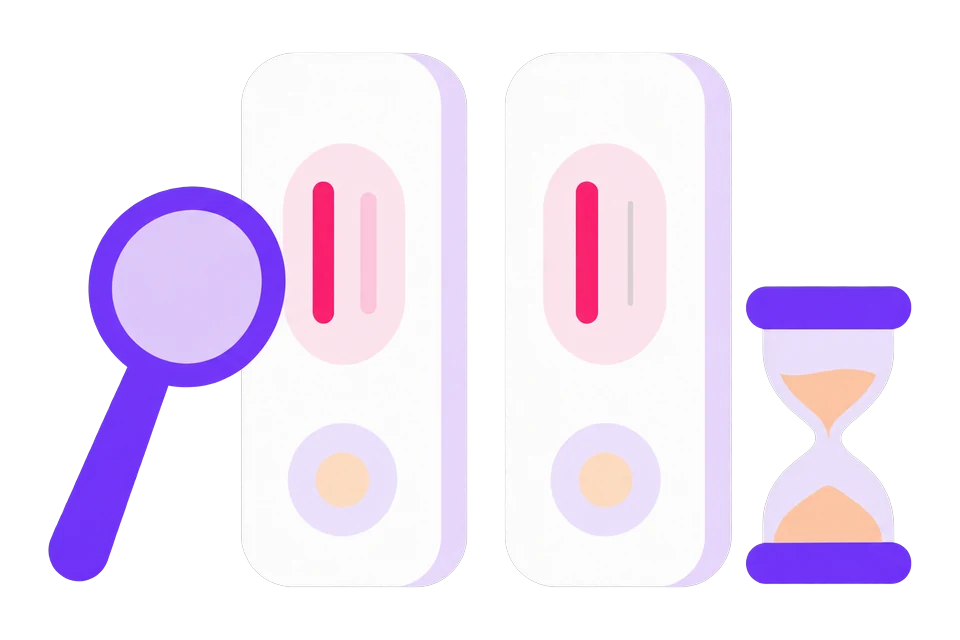
Pregnancy and fertility myths: true or false?
Eight things people often believe about tests and getting pregnant. Guess whether each is true or false.
A pregnancy test can work the day after sex.
The answers, with sources
Pregnancy tests
- Testing the day after sex: false. hCG is made once an embryo implants. The FDA says it can be found in urine 12 to 15 days after ovulation in a 28-day cycle, and the NHS says most tests work from the first day of a missed period. Our test date quiz works out your dates.
- First-morning urine: true. It is more concentrated, so it has more hCG in it.
- Late lines: false. Only read a test within its reading time. See evaporation line or faint positive.
- Diluted urine: true. Drinking a lot just before testing can make a line fainter.
- Positives are usually right: true. A negative is less certain, especially early. If your period doesn’t come, test again in a few days.
Ovulation and getting pregnant
- Ovulation tests prove ovulation: false. They detect the LH surge that usually comes before ovulation. Read how to read an ovulation test.
- Only on ovulation day: false. The egg survives about 12 to 24 hours, but sperm can survive three to five days, so the fertile days start before ovulation.
- Day 14 for everyone: false. Ovulation is usually about 14 days before your next period, so a 32-day cycle means ovulating around day 18.
Sources
by GetSolution.
Common questions
How long does sperm live inside the body?
Cleveland Clinic says sperm can live in the uterus for three to five days. That’s why sex in the days before ovulation can lead to pregnancy.
How long does an egg live after ovulation?
About 12 to 24 hours, according to Cleveland Clinic. After that the body reabsorbs it.
When am I most fertile?
In the days leading up to ovulation and on the day itself. Cleveland Clinic says sex may lead to pregnancy from about five days before ovulation to one day after. Ovulation is usually about 14 days before your next period.
Can drinking water affect a pregnancy test?
Drinking a lot just before testing dilutes your urine, which lowers the amount of hCG in it and can make a line fainter. First-morning urine is the most concentrated.
Can a pregnancy test be wrong?
A positive is very likely to be correct, the NHS says. A negative is less reliable, especially if you test early. If your period doesn’t come, test again in a few days.